Locally made
China Top Double Kitchen Sink Suppliers? This guide examines manufacturers that produce the Kitchen Sink Double for homes, apartments, restaurants, and renovation projects. China remains a major sourcing market, but supplier quality varies widely. A polished product page proves little.
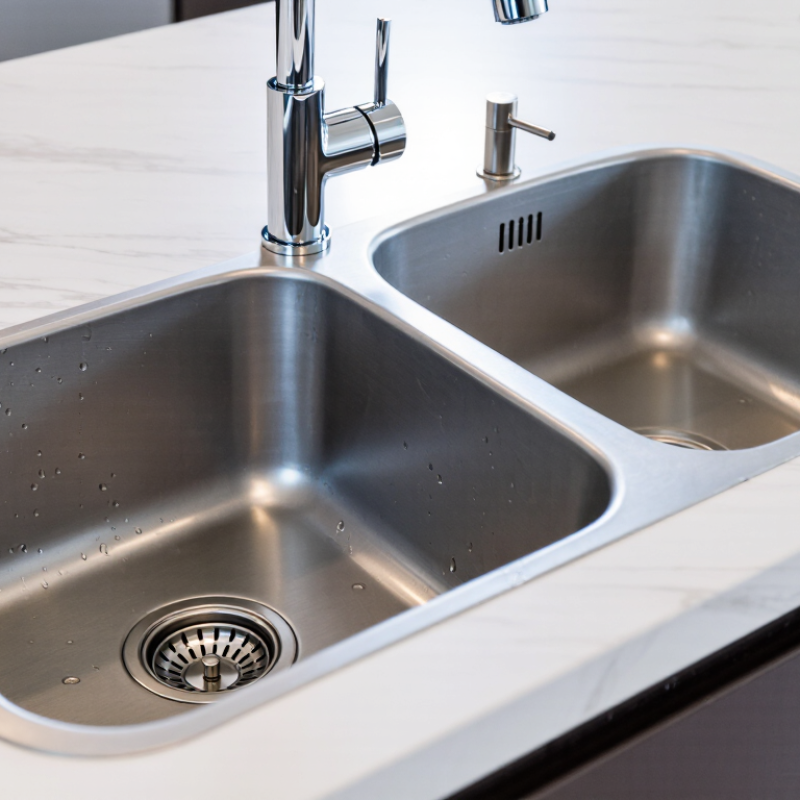
Susan Serra, CKD, a respected kitchen designer, has described the sink as “the workhorse of the kitchen.” That practical view matters. A double-bowl sink handles washing, rinsing, soaking, and food preparation in one compact station. The divider height changes comfort. Bowl depth affects back strain. Drain placement influences cabinet storage.
Reliable suppliers should provide clear details about 304 stainless steel, steel thickness, surface finish, sound insulation, and drainage performance. Ask for material reports, dimensional drawings, sample approval, and production photos. Better factories explain their testing process without hesitation. They also identify tolerances honestly.
Do not choose by price alone.
A very cheap sink may use thinner steel, weaker welding, or uneven polishing. These faults often appear after installation, not during inspection. Buyers should compare warranty terms, packaging strength, replacement support, and export experience. Certifications may support credibility, but they must match the actual factory and product.
This overview will compare leading China Top Double Kitchen Sink Suppliers through product quality, customization, minimum order quantity, delivery reliability, and communication. It will also consider details that are easy to overlook, including corner radius, basket strainers, overflow design, and cabinet compatibility. Some suppliers may look impressive online yet perform inconsistently. That is the uncomfortable part. Careful verification remains necessary.
China Top Double Kitchen Sink Suppliers?
A leading double kitchen sink supplier offers more than polished samples and competitive prices. Grand View Research projects steady growth in the global kitchen sinks market through 2030, increasing pressure on suppliers to deliver consistent quality. Reliable factories should provide material certificates, dimensional reports, and traceable batch records. The World Stainless Association reported 58.4 million tonnes of global crude stainless steel production in 2023. That scale makes material selection important, but steel availability does not guarantee sink durability.
Buyers should inspect the factory floor, not only the showroom. Check welding lines, polishing areas, drainage tests, and packaging strength. A dependable supplier can explain 304 stainless steel composition, bowl depth, corner radius, and noise-reduction layers without vague claims. EN 13310 testing principles can help assess kitchen sink performance, including drainage and resistance requirements. Small details matter. A badly positioned overflow can frustrate users daily.
Export experience also requires evidence. Ask for inspection records, loading photographs, and independent test results from recent orders. Production capacity should match the promised schedule, especially for custom double-bowl sizes. A perfect sample proves little. I would still question suppliers that refuse process audits or change material thickness after approval. Low pricing may look efficient, yet inconsistent gauges often create installation problems and higher replacement costs. Leading suppliers remain transparent when defects occur, although even strong factories can miss an occasional detail.

Common procurement criteria used when evaluating double kitchen sink suppliers, shown as a relative weighting of the overall supplier assessment.
Quality consistency and customization capability usually carry the greatest importance because they directly affect product durability, project requirements, and long-term customer satisfaction. Compliance, production reliability, logistics, and after-sales support complete the supplier evaluation.
When comparing China’s top double kitchen sink suppliers, study sink types and materials before judging price. The right configuration depends on cooking habits, cabinet size, and installation method.
Equal-bowl sinks suit homes that wash dishes and vegetables separately. Each basin usually offers balanced working space. Offset models provide one larger bowl for pans and a smaller bowl for rinsing. Low-divider sinks keep two washing zones but allow large cookware to cross the center. Workstation designs add ledges for cutting boards, colanders, or drying racks. They are practical, though accessories can make cleaning less convenient.
Stainless steel remains a reliable choice for busy kitchens. Look for clear thickness details, smooth welding, and a deep sound-absorbing coating. A thinner bowl may flex under a heavy pot. That matters. Granite composite resists scratches and offers a stone-like surface, but dark colors can show mineral marks. Fireclay has a bright, solid finish and handles heat well, yet it needs stronger cabinet support. Copper creates a distinctive appearance, although its surface changes over time and requires careful maintenance.
During supplier evaluation, request drawings, material grades, bowl dimensions, and drainage details. Check the corner radius with your fingers; tight corners often trap food. One overlooked issue is the drain position. It may interfere with plumbing or reduce storage below the sink. A careful supplier should provide inspection records and realistic tolerance information, not only polished product photos.
Evaluating Chinese sink manufacturers requires more than comparing prices. The ISO Survey 2023 recorded China as the leading country for ISO 9001 certificates. However, certification alone does not prove strong sink production. Request the certificate number, issuing body, and covered factory address. Then verify whether the scope includes stainless steel kitchen sinks.
Material control deserves close attention. Ask for the stainless steel grade, thickness tolerance, welding method, and surface treatment records. A reliable supplier should provide recent inspection reports, not only attractive product photos. The U.S. International Trade Commission and UN Comtrade data show China remains a major global manufacturing and export hub. That scale creates options, but also uneven quality. Some factories outsource polishing or drainage components without clear disclosure.
Tips: Request a sample from the same production line used for bulk orders. Measure bowl depth, corner radius, flatness, and drain alignment. Test water drainage and inspect the underside for rough welds. Ask for salt-spray or corrosion test evidence when the sink uses special coatings. Confirm packaging tests and carton specifications before payment. A video call can reveal useful details, but it cannot replace an independent inspection. No checklist is perfect; even experienced buyers can miss changes in subcontractors. Compare at least three suppliers using identical technical requirements, warranty terms, and delivery conditions.
China’s top double kitchen sink suppliers should prove more than low pricing. The ISO Survey 2022 recorded over 1.2 million ISO 9001 certificates worldwide. Certification helps, but it does not guarantee a flawless sink. Ask for a valid certificate, scope, factory address, and recent audit date. For food-contact areas, verify stainless steel grade, traceability, and compliance with EN 13310 or equivalent national standards. A reliable supplier should identify 304 stainless steel by mill certificate, not only by a sales label.
Inspect the factory’s production evidence. Look for automated cutting, controlled deep drawing, continuous welding, grinding, passivation, and water-leak testing. A 1.0–1.2 mm bowl wall usually feels more stable than thin sheet metal, but actual performance depends on geometry and reinforcement. Check corner radius, drain opening accuracy, sound-deadening pads, and overflow design. Production capability also means consistency. Request inspection records from several batches, not one carefully selected sample. The World Stainless Association reported global crude stainless steel production of about 58.4 million tonnes in 2023, yet material volume alone says little about sink quality. This is where supplier evaluation becomes uncomfortable: some factories show impressive equipment but weak process records. Confirm annual capacity, defect rates, corrective-action reports, and independent pre-shipment inspection. Even experienced buyers can overvalue polished showrooms. A scratched sample may reveal more than a perfect one.
China Top Double Kitchen Sink Suppliers?
How to Select the Right Supplier for Your Market Needs
Choosing a double kitchen sink supplier in China requires more than comparing catalog prices. Start with your market’s actual use. A restaurant may need deep bowls, reinforced corners, and strong drainage. A compact apartment may value a 60/40 bowl split and quieter insulation. Ask for drawings, steel grade certificates, and sample measurements. I once treated a polished sample as proof of quality. That was a mistake. The final batch showed uneven edges because production control was not checked.
Assess material and workmanship directly. Request the stainless-steel grade, thickness tolerance, surface finish, and welding method in writing. A reliable supplier should explain whether 304 stainless steel suits your application. Inspect the underside, drain openings, clips, and sound-deadening pads. Small details matter. Pour water into both bowls and observe drainage speed. Check for standing water around the waste outlet. These simple tests reveal more than attractive photographs. Ask for inspection records and a clear process for handling defects.
Your supplier must fit local installation and sales conditions. Confirm cutout templates, drain standards, packaging strength, labeling, and replacement-part availability. Calculate landed cost, not just the factory quotation. Include freight, duties, inspection, storage, and possible rework. Clarify minimum order quantities and production lead times before making customer promises. Communication quality is evidence, too. Slow replies may indicate future pressure, although not always. Request a pilot order with mixed sizes and record every issue. Review the results honestly, even when the price looks attractive.
| Evaluation Dimension | Recommended Benchmark | Why It Matters | Verification Method | Market Suitability |
|---|---|---|---|---|
| Bowl Configuration | Two bowls with practical separation; common layouts include equal or 60/40 bowl proportions. | Supports simultaneous washing, rinsing, food preparation, and drainage. | Review dimension drawings, bowl capacity, divider height, and installation photographs. | Suitable for family kitchens, rental housing, and standard residential renovations. |
| Stainless-Steel Grade | 304 stainless steel is a widely used baseline for indoor kitchen sinks; 316 may be considered for coastal or high-corrosion environments. | The steel grade influences corrosion resistance, durability, and long-term appearance. | Request material certificates or independent composition testing, such as XRF analysis. | 304 for general residential use; 316 for demanding coastal or commercial applications. |
| Material Thickness | Approximately 1.0–1.5 mm for many premium residential models, subject to design and forming method. | Greater thickness can improve rigidity, dent resistance, sound performance, and perceived quality. | Measure multiple points with a calibrated thickness gauge and confirm whether the figure excludes surface coatings. | Use the upper end of the range for premium, heavy-use, or commercial-oriented products. |
| Surface Finish | Brushed, satin, or nano-coated finishes with uniform grain and no visible polishing defects. | Finish affects stain visibility, scratch appearance, cleaning effort, and product positioning. | Inspect samples under bright light and perform cleaning, staining, and scratch-resistance checks. | Brushed and satin finishes are broadly adaptable; specialty coatings require local consumer education. |
| Installation Type | Offer the configuration required by the target market: top-mount, undermount, or flush-mount. | Countertop construction and installer practices vary significantly by country and housing segment. | Compare cutout templates, cabinet requirements, rim dimensions, clips, brackets, and installation manuals. | Top-mount is generally easier to install; undermount is common in higher-end remodeling projects. |
| Drainage Design | Sloped bowl bases, positioned drains, compatible strainers, and effective water evacuation. | Poor drainage can cause standing water, odor, mineral deposits, and customer complaints. | Fill each bowl with water, measure evacuation time, and check all corners for residual water. | Critical for all markets, especially areas with hard water or frequent heavy use. |
| Sound Reduction | Anti-condensation coating plus properly positioned sound-absorbing pads or undercoating. | Reduces noise from water flow, dishes, and metal contact while helping limit condensation. | Conduct a comparative noise test using the same water flow and utensil impact conditions. | Important for open-plan homes, apartments, and premium residential products. |
| Quality-Control System | Documented incoming-material, in-process, final-inspection, and pre-shipment procedures. | Consistent controls reduce dimensional variation, surface defects, leakage, and mixed specifications. | Request inspection checklists, defect records, corrective-action reports, and sample inspection results. | Essential for private-label, repeat-order, and multi-container purchasing. |
| Leak and Water Testing | Every finished sink should undergo a documented leak check before shipment. | Weld and drain-area failures can create installation damage and costly after-sales claims. | Require batch records and conduct independent pre-shipment sampling or 100% testing for critical joints. | Mandatory consideration for every market and product tier. |
| Customization Capability | Ability to adjust bowl size, corner radius, drain position, overflow design, finish, packaging, and accessories. | Local cabinet standards, consumer preferences, and retailer requirements differ by market. | Request engineering drawings, tooling information, prototype procedures, and revision-control records. | Valuable for differentiated retail products and regional kitchen-installation standards. |
| Compliance Documentation | Product documentation aligned with the destination market, including test reports, declarations, and packaging requirements where applicable. | Incomplete documentation can delay customs clearance, marketplace listing, or retailer approval. | Confirm report scope, product-model reference, issuing laboratory, test date, and destination-market requirements. | Documentation should be checked before production rather than after shipment. |
| MOQ and Sampling | Supplier should provide a clear minimum order quantity, sample policy, tooling cost, and sample approval process. | Transparent commercial terms help control launch risk and inventory exposure. | Obtain a written quotation showing sample charges, tooling ownership, lead time, and refund conditions. | Low-MOQ programs suit market testing; larger MOQs may support better unit economics. |
| Lead-Time Control | Separate schedules for samples, standard production, customized tooling, and peak-season orders. | Reliable delivery supports launch planning, stock availability, and retailer commitments. | Review historical delivery performance and include confirmed milestones in the purchase contract. | Prioritize documented performance over the shortest quoted lead time. |
| Packaging and Shipping Protection | Protective bags, edge protection, separators, moisture control, and export-suitable master cartons or pallets. | Sinks are vulnerable to scratches, dents, deformation, and carton damage during transport. | Perform drop, vibration, compression, and container-loading reviews according to the buyer’s logistics conditions. | Especially important for e-commerce, long-distance shipping, and mixed-container loading. |
| After-Sales Support | Written warranty terms, replacement-parts availability, claim response targets, and defect-resolution procedures. | Responsive support protects the importer’s reputation and reduces the total cost of ownership. | Review warranty exclusions, spare-part lists, claim workflow, and examples of previous corrective actions. | A key differentiator in mature retail and online consumer markets. |
| Supplier Assessment Score | Use a weighted score: product quality 30%, compliance 20%, delivery 15%, customization 15%, price 10%, service 10%. | A weighted model prevents the lowest price from outweighing quality and supply-chain risks. | Score at least three suppliers using the same evidence-based checklist and approved samples. | Recommended for structured sourcing decisions and long-term supplier selection. |